Showing posts with label Fun. Show all posts

Monday, November 23, 2009

Mr. Jack- Time's short, catch Jack the Ripper if you can!

I was contemplating on which game should I review next and that's when it occurred to me that I could continue my review with the Mystery/Deduction genre of games and hence Mr. Jack!

As mentioned in my previous review Cluedo was a sort of revival of my boardgaming interest. I always enjoyed the mystery themed games (not sure was this after Cluedo though), but one of the problems with the Mystery games that I had before getting Mr. Jack was that they were all 3+ players and above. Both Cluedo and Mystery of the Abbey and it wasn't that I always used to have 3 people that I could play with. Also, I was looking at a shorter game ('cos Cluedo and MoA takes about 60-90 min).

After some reading around, I found the answer in Mr. Jack. Got it through a friend of mine from Singapore. This is a 2-player murder mystery themed game that takes about 5-10 min to learn and takes about 30 min to play.

Mr. Jack by Bruno Cathala & Ludovic Maublanc
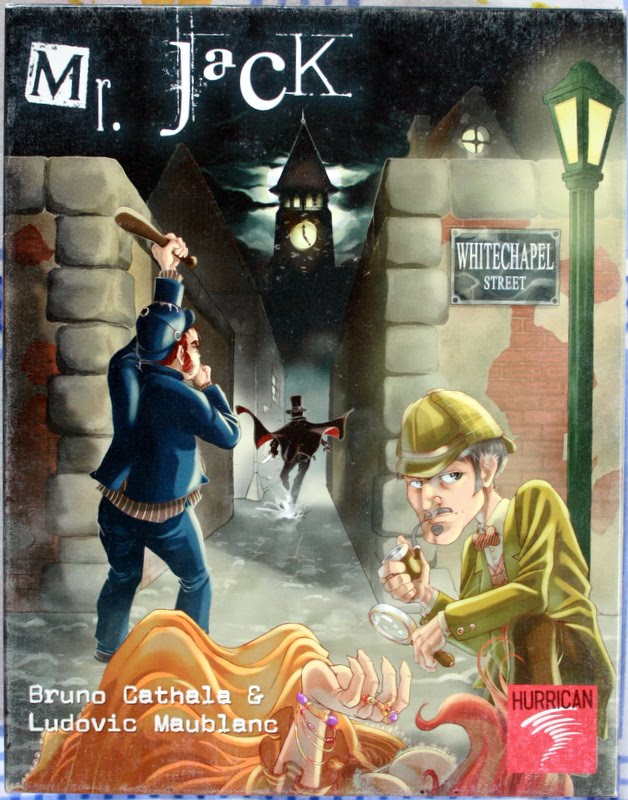
Both Bruno and Ludovic are French game designers. Bruno has designed one of the most popular Co-operative games Shadows over Camelot (more about it some other day :-)...) and Ludovic has designed another popular game called Cash 'n' Guns a fun game like Bang!

What do you get in the Box?

Well before I go to the content bit, I have to share how I felt after opening the box ;-) As I mentioned before I had read a few reviews about this game and thought that this was a simple enough game for 2 players. I wasn't completely into lot of strategic Euro games and hence wanted the game to be simple (things are different now though).

When I opened the box and saw the rule book, I almost fainted looking at the size of it!!!! It is a 38 page magazine!! and I thought that I had blown up money on this one. But don't fret :D as I realised moments later the rule book comes in 7 different languages and hence so big. In actuality the rule set is just 5 pages :-)


Now to the contents:
  • You get a nice big board with lot of hexes
  • 8 character tokens with suspect on one side (dark color) and innocent on the other side (white background)- Characters come from the popular Sherlock Holmes series like Sherlock, Dr. Watson etc.
  • 6 hexagonal gas light tiles with 4 of them having numbers1-4 for removal after each of rounds 1-4
  • 2 hexagonal manhole tiles
  • 2 police cordon tokens
  • 1 turn counter token
  • 1 card witness/no witness indicator
  • 8 cards with green back with the names and pictures of the character along with their special abilities
  • 8 alibi cards with red back and picture of a character on each card
The quality of the components are top notch with really thick cards and absolutely brilliant art work! In fact I'm wrong in calling these cards as cards, they are really really thick boards!

How does it play?

First let's look at the set up before we see the game play:
  • Set out the board look the the cover page of the rule book to set out the gaslight markers, manhole markers, police cordon tokens and the starting positions of the 8 characters with their bright/darker side up
  • Place the turn counter token on the bottom right corner of the board where it says 1
  • Choose a player who is going to play lack- he gets the witness card and draws one of the character cards from the red back stack
  • Shuffle the 8 green back stack and draw the top 4 cards and keep it open next to the board
  • Ensure that the player playing Jack faces the grey side of the board (upside down) and the detective player faces the board upright (gold side)
Now we are all set to play :-) If you noticed I haven't mentioned the objective of this game. Well if you read the above section of set up that gives you the clue to the game. One of the 8 characters is Jack the Ripper i.e. the card the Jack the Ripper player chooses is the culprit. The other player has to find out this guy, and to make matter tense you have just 8 turns in which to do that! Of course did I mention that if Jack is clever he will escape from the city (board) even before you get to the 8 turns!! So buckle up you are in for a roller coaster ride!

On each turn the following happens:
  • The turn order token tells you the order of play. Eg: Grey-Gold-Gold-Grey (for turns 2-4-6-8) or Gold-Grey-Grey-Gold (for turns 1-3-5-7)
  • Players choose one of the open character cards depending on who they are representing (see above of grey and gold description)
  • Players move the character tokens on the board as per the movement points for each character and use the character's special ability. E.g. Sherlock can move upto 3 places and draw a card from the red back pile etc.
  • After a turn is over i.e. 4 cards the Jack player uses the witness card to indicate whether the culprit is visible or invisible.
  • Once this is done, depending on whether the culprit is visible or invisible the tokens are turned around to indicate their innocence. Meaning- if the culprit is visible then all the invisible characters are innocent and vice verse
  • The turn counter moves to the next number and one of the gas light is removes from the board (numbers 1-4 for each round)- i.e. your city is going get increasingly darker and becomes difficult for the detective to catch Jack ;-) so hurry up
Note on Visibility:
  • Any character adjacent to another character is visible
  • Any Character adjacent to a gaslight is visible
  • Any character in the line of sight of Dr. Watson's gaslight is visible
  • All other characters are invisible
  • Jack can escape the city only when he is invisible and through one of the exits that does not have the police cordon marker!
Now for the fun element- Well it is extremely important for players to use the gas lights to their advantage and also the manholes. Using manholes can absolutely turn things around for players. There is no luck element in using the manholes, but there is surely a surprise element! Add to this the special abilities of the characters are really important and if used wisely can enrich the gaming experience immensely.

How long does this play?


Typically each game should last somewhere between 20-30 min, yes it is that short though my review makes the game appear long. In very rare circumstances I've seen games stretching upto 45 min (i.e. when I play this game with some serious chess players :-)

Who would you recommend it to?


I would categorise this game as a light-medium game and hence this can fit into most game collections with ease. Serious gamers can use this as an ice breaker before they want to get into something really serious and casual gamers can play this for hours before getting bored :-) I would say this is a great game for get away- so couples might find it very attractive, but if you are a person who plays games with larger groups and seldom play 2 player games, then you may not want it because this is a 2-player game :-)

Any Downsides?

Well I had to think long and hard before writing this section. Downside of such a nice game, well can it really have one? The answer to me was yes, and I say this as I have played this extensively for over 2 yrs now- One serious downside is games tend to become repetitive after you have played many times. There are actually 2-3 different strategies and once you crack them in your initial games the surprise element might die down. Playing with different players will give you different experiences as the style of play will be different, but you can nail down the trends after a point in time.

For beginners learning the movement abilities and special abilities might take a game or two, and if they play against experienced gamers there is a huge disadvantage. This game is also fairly unforgiving in that if anyone commits a simple error early in the game, you can be sure that your game is going to be short- specially true with errors made by players playing Jack.

Personally I feel that this game is not very well balanced- what I mean by this is, it is very difficult for Jack to escape and not get caught. After some games you know that Jack will get caught (experienced gamers) and the challenge is how long can Jack keep running away. For this I do play certain variants like playing it for 6 turns instead of 8, removing 2 lamps instead of 1 etc. but still the detective has a lot of advantage unless he plays really stupid.

Final Thoughts!


Well don't get carried away reading my downside section and dismiss this game as a flash in the pan. This is a very very good game and can keep you engaged for hours, days, years. Though I don't play it very often, I do see this game hitting my table every other month at least for a couple of games. Yes there are some drawbacks, but I guess there are very few games that are perfect. If you ask me this game is perfect to satisfy your mystery/deduction itch without brain burn within a short time! With an expansion and a full blown game released I can only imagine this game getting more and more popular! As I said before catch this Jack before he escapes from the market stands.

Tuesday, November 10, 2009

Cluedo- Prof. Plum, in the Studio using a Candle Stick!

I guess I would be wring calling this a review. This game is so popular that it doesn't need a review. For more than 60 yrs this Parker Brother's game has intrigued people and I should add, is still continuing to do so. I say a great game to introduce mystery genre games for newbies (3-6 players)

I have lot of people on Boardgame Geek tell that Settlers of Catan was a genre breaking game that actually got a lot of them back to boardgaming. But I'm a little different. Coming from India, my knowledge of boardgames was extremely limited to say the least and this game actually got me into boardgaming and hence a special affiliation towards Cluedo :-)

I was probably one of those in India who had no clue about this game, though some of my friends had played it years ago. Unfortunate is all that I can say. But all this changed when a friend of mine showed me this game in Target or Big W in Melbourne i.e. during B-School days. He said "why don't we pick this game up for our weekend?" We were supposed to have some friends at my home and spend time and he suggested that this was an interesting game.

This set the ball rolling :-)

Cluedo the age old game of mystery and intrigue has reached immense heights where people host Cluedo Parties, murder Mystery parties etc. All that is required is to identify a hypothetical murder that has taken place- you need to tell who don it, with what weapon and in which room. In fact there has been many better murder mystery games after this, but to me this stays close to my heart!

BTW, this is available across all stores in India and don't wait to read this review to buy this game :-) If you look at my pictures you can probably make out how worn out this game is- i.e. how much I've played this :-)

Cluedo or Clue by Anthony E. Pratt

Anthony E. Pratt (August 10, 1903 - April 9, 1994) was an English game designer who is credited with creating the popular board game Clue. He came up with the game idea while working as a fire warden during World War II in Leeds. He was inspired to create the game by Geoffrey Bull, inventor of the board game Buccaneer. (Boardgame Geek)

What do you get in the Box?


This game perhaps comes in so many flavors that I really can't say with certainty that there are the things in the box. But the Parker Brothers version that I have has the following:
  • Nice big game board depicting 9 rooms
  • 6 colored pieces representing 6 different characters (Ms. Scarlet, Mrs. White, Prof. Plum, Col. Mustard etc.)
  • 6 miniature weapons (knife, revolver, candle stick, rope, wrench, lead pipe)
  • 9 room cards
  • 6 weapon cards
  • 6 character cards
  • Dice and deduction sheets
Neat components. Also you can download deduction sheet from BGG whenever you run out of it or create your own.

How does it play?

  • Each player chooses a character, gets deduction sheet and start off from their respective character's starting position
  • one card at random is chosen from each of the 3 stacks i.e. character, weapon, room) and set aside. This is what is needed to be deduced.
  • The rest of the cards are distributed among the players and it doesn't matter if is it unevenly distributed.
  • Ms. Scarlet starts 1st, else choose a way that you like
  • Throw the dice and move the counter towards the entrance of any of the rooms that you want to enter
  • Once a player is at the door step others can't enter the room
  • Another player cannot enter the room already having a detective by throwing a dice
  • How ever other characters can be summoned by detectives on their turn to the room that they are currently present
  • Players can suggest/suspect using the following combination- Character name- Weapon- The current room that they are in. Eg. Scarlet-revolver-kitchen (assuming the player is in kitchen)
  • Players can suspect/suggest themselves as well i.e person playing Scarlet can suspect Scarlet themselves
  • Note: Players cannot suggest that the murder happened in another room by staying in one- so you cannot stay in Study while suggesting the murder happened in Ballroom
  • After a player makes a suggestion he/she goes round the table asking if anyone has an objection to that combination. If they have they must prove it showing one of the cards of the combination (i.e in case more than one card of the combination used). Remember all players have to be truthful when it comes to objecting and cannot bluff.
  • Play continues like this round the table until a time when someone comes forward to accuse- Each player gets just one chance to accuse. i.e by accusing you are publicly saying that you know he combination of room, character and weapon and you take a look at the hidden cards. If you are right you win, else you are out of the game. Even if you lose you have to be present in the game to show the clues to others. So be very sure before making an accusation
  • If you have a winner, people can decide if they want to continue the game or each one can go and make an accusation (this is how we play)
People use some interesting strategies like using clues from their hand and trying to mislead others into believing that the combination is a strong possibility of being the right answer ;-)

How long does it play?

This game usually takes somewhere between 45 min to 75 depending on how experienced your group is. But this game is fun so don't worry about the time :-)

Who do you recommend it to?


Well, I would like to say that this game is for all. But yes, if you are starting out on boardgaming and have no idea about what board games are, you should not miss this one. Yes I do accept that there are better games, but this is surely one of the good games. If people have been playing it for more than 60 yrs, I surely believe that there is substance to play this game.

Any Downsides?


Having said that this game is fun, enjoyable etc. this game is not without flaws. One thing that really makes this game annoying after you become comfortable is the dice mechanism- unnecessarily slows things down. This is where games like Mystery of the Abbey- MoA (which I own as well) scores over Clue. After many plays you'll exactly know that there are 3-4 different strategies to crack this and it is just a matter of time before someone cracks it. Again games like MoA or American Werewolf or Werewolves of Miller's Hollow (the last 2 are very different to MoA and Clue) scores. Some people find it hard to keep track of things on the small deduction sheet. Some people have also complained that this game is more of an elimination than deduction. But honestly I have played this close to 80 times and still don't mind playing it, though the preference has gone down a bit.

Final Thoughts!


This game got me into Board gaming and just for that reason alone, I'll not be getting rid of this game :-) I still get kicks playing this, but definitely enjoy MoA more due to the mechanics involved and the complexity involved. Having said that I would say this game should be played by everyone in case you have not played it before. I really don't mind if you don't want to buy, but not playing this is a crime :-)

Wednesday, November 4, 2009

Fearsome Floors!- Escape or get Eaten!

Let me start of November with a game that rocks! Perhaps one of my 1st games that is really a big box i.e. bigger than any of my previous games and one that can be learnt in 5 min, but can give you hours of laughter :D for 2-7 players

Well what is this fun game all about?

You and your friend/friends are in a dungeon/palace or whatever you want to call it and trying to escape from that place without getting eaten by the monster that roams the corridors. What awaits you is a trail of death, blood and horror!!

Well the last part should read- What awaits you is a fast paced, exhilarating fun game that will make you come back many times!

This was a game I had no idea about. My brother was in Singapore and called me from the game shop telling me that a particular game that I wanted was not available and put me onto the shop owner. He strongly recommended me this game and I was very hesitant till I played it. But boy was this a good buy!

Fearsome Floors by Friedemann Friese


Friedemann Friese is a German board game designer who is known for pairing interesting gameplay with quirky themes. He is notorious for liking the color green, to the point which he includes the color on the cover of all of his designs, and has dyed his hair green. He also likes to begin every word in his titles with the letter 'F,' though this trait is sometimes lost in the English versions of his titles. He designs exclusively for his own game publishing company, 2F-Spiele. (From Boardgamegeek website)

He is known for a lot of good games, you can see the list http://en.wikipedia.org/wiki/Friedemann_Friese

However the best game from this designer has to be Power Grid or Funkunschlag(in German) (currently ranked # 3 on the BGG site). I will be writing about that game sometime in the future, but this game is a must have just for the fun element!

What do you get in the box?

Well you get some really nice stuff inside the box:
  • 1 Big game board
  • 17 floor tiles (stones, turning tiles, teleporters, blood pools!! oooo, etc. etc.)
  • 8 Monster movement tiles
  • 1 Starting Player marker
  • 25 playing figures in 7 colors (4 each in 4 colors and 3 each in 3 colors) representing characters from Adams Family!
  • 1 DIY (Do it Yourself) Monster kit (This is fun, believe me)- fix the head, shoes, hands and create about 3-4 different monsters
I have the Rio Grande published version and the quality of components is top notch!

How Does it Play?


1st the game mechanic:
  • On your turn you move 1 or more of your markers as per the number indicated on the figure and then turn the disc around to show the other side- each marker is a round disc with a number on each side of the disc totaling upto 7 (so you have characters with number combinations like 5-2, 6-1, 4-3 etc. you can differentiate the sides by the black and colored backgrounds)
  • Once all players move their characters they draw a monster movement tile and move the monster as per the number printed on the tile
  • The game plays for 15 rounds (monster tiles are exhausted after 8 turns and the last 7 reshuffled to form the next draw pile)
  • Player who manages to get most of his characters out is the winner!
Simple enough right :-) Here's what makes this game fun:
  • On your turn you move a character and turn it around- so if you had the 4 side up, you can move your playing figure upto 4 spaces (any direction except diagonal) and turn it around with its 3 side up- so the next time it can move only 3 steps
  • Monster moves in a straight line and can see in all directions except back side ;-)
  • Monster moves till it sees a playing figure, upon which it changes its direction and moves towards the figure
  • If 2 playing figures are equidistant, the monster continues in a straight line so make a smart move and trap your friend!
  • Monster can't see characters behind stones so go behind stones, or move using stones as a shield, but be careful the monsters can crush you if you don't get out of their way as they can push the stones with ease :D
  • You can slide over blood pools and maximize movement
  • Monster goes through walls! This mechanic is just the killer for which you should get this game- i.e. the board is marked with letters and the monster goes through one side of the wall say A and comes through A from another side, so all characters who felt were safe once are now in grave danger of getting eaten!
  • In the 1st phase i.e. drawing the monster movement cards from the 1st 8 times you get a chance to come back even if you get eaten, but the next 7 rounds, you get eaten and you are one character short
  • The whole game is about meticulously placing your pieces so that you don't get eaten, but at the same time are progressing towards the exit!
  • Monsters don't stop till the number of movement points are moved, so they can really surprise you when they start to move. You might be thinking that you are safe, but a smart player can expose you and make you look like a fool :D
  • There is another mechanic that makes this game beautiful i.e. the one and 2 hits. Whenever this comes up, monsters move upto 20 spaces till they find a victim, so be sure you are not one of the victims ;-)
All this augers for an exciting game that you can play which ever way you want- either light or heavy i.e. if you want to plan your moves meticulously like in chess, you can do that and play this really deep or just move around and have fun!!

How long does it play?

It depends on how many players you are playing with. With 2-3 players you should be able to get a game inside 40 minutes, but with 4+ players you can have a full game lasting 60-75min! I would say more the people more the fun. Just don;t get too deep and try to play it like chess, this might take away some of the fun element out of the game!

Who would you recommend it to?

I definitely think this is another game apart from Bang! that everyone should have. So simply go and get it. It is light hearted fun that will make you come back and play more everytime you bring it out. It has an advanced version with teleporters and turning stones which makes it a great game for replayability!

Any Downsides?


If you have players who get into the thinking mode like chess, downtime increases and the fun element goes down a bit, so keep pushing players to make quick movements! Apart from this I don't see great downside to this game. You have to be a little careful with the monster bits as they can wear out by constant assembling and dismantling.

Final Thoughts!

This is a very underrated game according to me. If you see the ranking on BGG- it is ranked #359, but I highly recommend this game purely for the fun factor it can deliver. Accepted that there might be limitations on the strategy part, but I feel not all games need to be strategic to give you kicks, it can be pure fun that can leave people saying, wow we had a good laugh for about an hour. I think this game is a must for everyone! It can be a great family entertainer though some may offended by the theme! (which is very rare).

Scales up beautifully across 7 people and light at the same time. You can use this as a great get-away game as well. So simply get it!

Friday, October 30, 2009

10 Days in Asia! - See Asia in 10 Days

Well, not really see Asia, but yes, you can see Asia's map and get familiar and go to possibly 10 different countries in 10 days! Well that's what this game is all about. Traveling! around Asia. I had read about this series i.e. the 10 Days series (it comes in 4 variants- 10 Days in Asia, Europe, Africa and USA) and some of them had mentioned that this was the best among the lot and a good introductory game for people into boardgames.

While I can't comment on how good the rest are, as I haven't played them, I agree to some extent that this can be a good introductory game for children rather than adults.

This is perhaps my 1st of the bigger boxed games (probably you can't make out the size though my photos), but this is bigger than any of the games that I've reviewed so far.

Before I go into the game- if you have kids at home, get the entire series, it can be a good geographical experience for them, they will surely learn to locate countries and can learn about their capital, population and the size :-)

10 Days in Asia by- Alan R. Moon & Aaron Weissblum


Alan Moon is one of the most recognized active game designers and a two-time Spiel des Jahres winner. He is the organizer of the annual Gathering of Friends. Moon is an infrequent contributor to Board Game Geek under the username alanrmoon.

Moon began in the game industry with Avalon Hill as an assistant editor of Avalon Hill's magazine The General in 1979, but due to Avalon Hill's small staff quickly found himself also working as a game developer. Moon himself chronicled this time of his life in the geeklist My Four Years at Avalon Hill. He eventually left Avalon Hill in order to make a more livable wage at Parker Brothers' video division. He stayed at Parker Brothers only briefly, soon leaving to try becoming a professional game designer.

Moon worked as a game designer part-time, while taking consulting jobs and waiting tables to make ends meet. However, Moon was unable to find any success marketing his games to the larger publishers. Eventually, disheartened at the inability to find major publishers interested in his games, he co-founded White Wind in 1990 to publish his own designs. White Wind met with limited success, and Moon eventually left to again pursue design work for other publishers. In 1998, Amigo Spiele asked Moon to simplify Elfenroads, a 1992 White Wind release. Moon's resulting redesign, Elfenland, went on to win the 1998 Spiel des Jahres, establishing Moon as a premier game designer. He has since worked with many major publishers, and has enjoyed great success. Some of his reations include- Diamant, Ticket to Ride (btw this is a legend), 10 Days series etc. (from Boardgame geek website)

Aaron Weissblum is a game designer who frequently designs games with Alan R. Moon including popular games such as San Marco, the 10 Days in series, Capitol, Oasis, and New England. He is also one of the co-founders and puzzle creators for Tanga.com and has designed Puzzle Hunt contests for BGG.CON. (from Boardgame geek website)

What do you get in the Box?

For a light game, the box is very heavy! You'll see why :-)

  • 78 tiles (57 Country tiles and 21 transportation tiles)
  • 4 sets of wooden tile holders, 2 per set (this makes the box heavy). These wooden hilders have Day 1- Day 10 printed on them to keep the tile in the appropriate slot.
  • A nicely printed map of Asia
The game is printed by Out of the Box and the quality of components is top class, though they could have made things light.

How does it Play?

  • Players take tiles 10 of them from the face down draw pile and place them one after the the other without changing the order
  • One placed they cannot be moved
  • Place 3 tiles face up, which forms the discard pile

This is the initial setup and then the players start:

  • On your turn, you pick up a tile either from the face down pile or from any of the face up discard pile
  • You must place this tile by removing one tile from your tile holder, which is then discarded onto any of the 3 piles
  • You may even discard the card you have just drawn
That's it, these are the rules. very simple right! The first to complete a logical route of 10 days is the winner!

Of course there are some aspects that needs to be adhered to while completing a route:

  • Completed10 day journeys should start and end with country tiles and not transporttion tiles
  • 2 tiles from the same country may be included so long as they are not next to each other
  • It is not necessary to include any trasnportation tiles in your route
  • Transportation tiles cannot be placed next to each other
Now having said all these how do you connect?
  • Any country that is adjacent can be traveled by road, so just keep it next to each other
  • On the map is the rail route connecting countries and hence you can use a Rail tile to connect those 2 countries
  • Each country has a color code (5 colors in all). So you can use an aeroplane of appropriate color and connect it to another country of the same color. Eg. India (brown)- Brown Aeroplane- Russia (brown)
  • Countries can be connected so long as they are on the same ocean i.e. Indian or Pacific.
So not fussy at all, pretty straight forward to learn and play :-) There is very little strategy or tactic as everything is based on tile draw, though some nasty things like placing a tile on one of the discard pile to prevent your opponent from getting a tile that you know he/she wants is a fun thing to do :-)

How long does it play?

With a really bad set of tile draws the game can extend upto 30 minutes, else 15-20 min is what you are looking at. Of course with 4 people, you can say it might be a 30 min game on an average. So pretty fast.

Who would you recommend it to?

Well I would say any household with young kids should have the entire set, just because parents can sit with kids, have fun and also learn some basic geography stuff! These games are available in popular toys/book strores across India, so you should get these ones. Otherwise I would say give this a skip as this becomes too boring with limited replayability.

Any Downsides?

Even casual gamers might not get into this game as it is too light. One say a very rare ocassion you might get a play or two, but that's about it. With luck playing such an important role, very difficult to induce gamers into this game :-)

Final Thoughts!

Well, though this game is simple and fun, I would strongly recommend this to only families with kids as they can enjoy more than a grown up adult gaming group. But as a laerning to know where countries are, this can be a fun game of and on! Try it if you get a chance before you buy! I would say for people with Children, get all the 4 games and play 40 days around the World!!

Monday, October 26, 2009

Bohnanza- To Bean or Not to Bean!

After that short little tip on photographing fireworks, I;m back again with a game review. This time an introduction into negotiation based games.

Bean planting might be the most boring/blandest theme a game could have right? Well not true, really this game is a very light negotiation game, that can generate a lot of noise!

I saw this game on the shelves of Brew Ha ha couple of years ago and thought that I should give this a try. My brother was in Singapore later that year and I asked him to get this game as this wasn't that expensive to get.

This game again is a lot of fun with a mid-sized group, say between 5-7, even though 2-7 players can play. This is a light game and is a very good game to get people into negotiation based games like Modern Art, Traders of Genoa, Ra etc.

Being a light game, everyone in the family can join in and have fun!

Bohnanza by- Uwe Rosenberg


Now this guy is another prolific game designer, some sort of a genius! He is a German game designer. He became known mainly through his card game Bohnanza, which is successful both in Germany as internationally.

He also designed Agricola, a game that dethroned Puerto Rico as the #1 game on BoardGameGeek.com. Rosenberg first began to occupy himself with the development and mechanisms of games during his school years. During that time, he published a number of play-by-mail games, some of which are now available at www.omido.de. When he was a student, Amigo published his best-known game, Bohnanza. Since finishing his statistics studies in Dortmund (the subject of his thesis was "Probability distributions in Memory"), his main occupation is the development of games. (Wikipedia)

What do you get in the Box?


Cards, Cards and Cards. You get 161 cards!
  • 154 Bean Cards (the box comes with 11 different bean varieties in differing quantities)
  • Seven 3rd Bean field cards
The art works looks nice and the version I have is from Rio Grande and hence quality impeccable!

How does this play?


Well, I haven't mentioned much about the game play throughout as I wanted to keep that completely in this section. Perhaps this is very different to other games that I have reviewed.
  • Each player gets a hand of 5 cards- but the most important aspect of this game and in fact the factor that makes this game different is that players should not change the order of the cards that they have received or receive in the future!
  • Each card has a number on the left hand side that tells players how many cards of that variety exists and at the lower part of the card a conversion table for harvest is given. i.e. if you harvest 3 bean cards of a particular variety, you get 1 gold coin.
  • While I told you that this game has just bean cards, all the cards have a gold coin symbol on the back side and hence very neatly manufactured components
  • Players try to plant bean cards (2 varieties if they don't have the 3rd bean field card, which costs 3 Gold), harvest it and make profit! That's it!
On their turn the following things happen:
  • Players must plant bean cards (one or 2) from the top of their hand
  • Draw 2 more cards from the pile, plant, donate or negotiate a deal (this my friends ROCKS)
  • All players plant the traded/donated cards
  • Finally the player draws 3 more cards from the pile and puts it at the back of the hand of cards again to maintain the order. However when you are negotiating, you can bring out the cards from your hand (but remember, you can't put it up the table, you can just call it out for negotiations and finally when someone trades, you them the cards) This is an interesting tactic that can change the order of cards to suit your convenience.
Well the entire fun part of the game is in the negotiation phase, where things really hot up, voices reaching the top of your roof, people screaming to close a deal and this is fun!

How long does this play?

Well typically the game suggests that you play 3 rounds (one round is when draw pile empties). After each round the size of the pile reduces as the gold that you make is the bean card turned over. So a full game should take you about an hour. But I play just one round and stop it (have reasons for this), which takes about 20-30 min.

Who would you recommend it to?


Well, here is where I have some reservations about this game. Yes, the negotiation part is fun, chaos, but becomes repetitive and soon people get into a rut to close deals faster that takes the charm out of this game. After the 1st few rounds the group more or less tends to close deals rather than extend the negotiation long and hard. Hence I play just the one round and would suggest all of you out there to try out a few rounds or a game or two and then decide to buy this. This game of course comes with tons of expansions so may have replayability. As I haven't played any, I wouldn't be able to judge that aspect.

Any Downsides?

I've actually mentioned the downside above and this to me is the greatest downside. Uwe created this game when he was at school, so lot of young people may find it very good, but if you are a serious gamer, I will surely not recommend this.

Final Thoughts!

As I mentioned before, this is a very good family entertainer, meaning parents with children can have a lot of fun. Or non-gamers/occasional gamers can play it during a party to get some excitement going. If you are a serious gamer, I would say stay away from it as Uwe has master pieces like Agricola, Le Havre that you will enjoy.

Thursday, October 15, 2009

BANG! - I Shot the Sheriff!!

I shot the sheriff, but I did not shoot the deputy- Bob Marley

Guess most of us have heard this song, well even if you haven't don't worry. The reason I put that line up is because this game is all about shooting people down!! Well not in the real sense, but using cards! And my word is this game fun!! I have not seen a simple pack of cards pack this much punch.

The game is like:

Sheriff: I'll kill all these outlaws and restore peace!!
Outlaws: Let's kill the sheriff whoz in our way!
Deputy Sheriff: Oh no! I can't let the outlaws harm my boss!!
Renegade: Ah haa!! Here's is my best opportunity to eliminate everyone and become the new sheriff!!

Well this is the game in a nutshell. This game is truly multi-player in nature in that it can accommodate 4-7 players. So finally I've come to multi-player games! This my friends is an absolute no brainer, so even before you read the review, just pick this one up..period.

I played this for the first time with a group of strangers at Brew haha (my friend's board game cafe') and fell in love with this and ordered it immediately.Ever since whereever I've been in mid-sized groups this has been a smash hit. So much so that I had to refrain from playing as they became addicted to this game!

This is a fighting, bluffing, little bit of mystery, classic western, role playing (some of my RPG friends may take offense to this being called a Role Playing Game, but it is in a very simple sense though)!

BANG! - By Emiliano Sciarra

He has been fascinated by games from when he was 12 years old, and he wrote simple board games and word games for his schoolmates and relatives. In the same time he also showed interest in computers (years later he earned a degree in Computer Science at Sapienza University of Rome).

In 1988 he published his first game: a shoot 'em up videogame for the Commodore 64 called Ciuffy (Systems Editoriale), created using the software SEUCK by Sensible Software.

Starting from 1999 he wrote several reviews, games and articles for the magazine PowerKaos and the fanzine Un'Altra Cosa, along with a brief "Little Informal Dictionary of Computer Science" (Piccolo Dizionario Informale di Informatica). His topics included logic puzzles, original games and theoretic discussions about the meaning of the game and its role in the human society.

In 2002 he published with daVinci Editrice, which was born shortly before, the card game Bang!, created two years earlier. Sciarra decided to submit the game after the members of the local Chess Club (founded by Sciarra himself in 1998) were so addicted to the game that they preferred to play Bang! instead of Chess!!

Bang! hit the shelves in July 2002: without any marketing by daVinci, the game entirely sold the first run (2400 copies) in less than three months, instead of the three years estimated by the company. According to official figures by daVinci, the game sold more than 500,000 copies and is distributed in 14 countries over the world!! (Wikipedia)

The version that I have is from Mayfair games- a publisher of board and roleplaying games in the United States and United Kingdom. They also license German-style board games and publish them in English, most notably the The Settlers of Catan series licensed from Kosmos. (Wikipedia)

What do you get in the box?

As I mentioned before this is just a small box of cards. Exactly the same sized box as any playing card deck:

  • 7 role cards. The roles are- 1 Sheriff, 2 Deputies, 3 Outlaws and 1 Renegade
  • 16 character cards. Each player chooses one for the game
  • 80 Cards to play
Please don't get fooled by the components. I know some of you might wonder how come Madhu is harping about this game and this game comes just with some cards! You'll see that in the next section.

How does it play?

I'm not going to go through the entire rule set, but goving to give you all an overview of howthis game flows:
  • Each player get a role card viz. Sheriff, Outlaw etc. and the Sheriff reveals himself/herself. Of course the number outlawsetc. change with the number of people
  • Each one is then given a character card that talks about the special ability of the character and also the number of lifepoints indicated by the number of bullet. Now this character card plays the role given to you. E.g. Bart Cassidy one of the characters might play the outlaw, Willy the Red might play the Sheriff.
  • Each one gets another character card, but this one he keeps it face down with the bullet seide up and coveres it using his previous charecter card to indicate the number of life points. Note: The sheriff has one extra life point as he discloses himself!
  • Each player gets 4 cards as a starting hand.
This is the game set up and now the shooting can begin!
  • The sheriff starts the play
  • During any players turn, they draw 2 cards from the draw pile
  • Play as many cards as they want or not play any as well! (which btw is very rare)
  • In case they have more cards than their current life points they discard down to match the current life status
With such simple rules, you might wonder where is the fin element?
  • The playing card deck comes with a variety of cards, but the most important ones are the Bang and Missed cards. Use the Bang card to shoot someone and missed card to avoid the hit!
  • Apart fromthis there arespecial blue cordered cards that give you additional powers like increasing your range of shooting(each person starts with a range of one, meaning they can shoot players who are next to them, either side)
  • They can put others in Jail (not the most pleasant thing to do)
  • Indians attach so shoot them down
  • There is a machine gun attack so avoid or get hit!
  • Someone can take away your powers!
  • Someone uses a dynamite!
  • Oh my God! I'm hit! I'm hit! drink beer and save yourself!!
Many many more fun options to play it. There is never a dull moment in the game and it is high voltage action all along. But for the Sheriff none of the other players reveal their roles, so it is going to be a game of cat and mouse trying to guess who is on whose side!

  • If the sheriff and his deputy kill all the outlaws and Renegade they win
  • If the outlaws kill the sheriff they win!
  • If the Renegade manages to be the only one alive- he wins (this btw is the most difficult role and fun role to play)
You don't know who's on whose side, but you keep guessing and shooting at people. There is going to be chaos, pandamonium and lots and lots of laughter.

There is limited amount of strategy, but this game was not supposed t be a strategy brain burner, but just a game of unadultrated fun and laughter for the family and friends alike.

I've seen people seeking revenge the next time around when they play completely disregarding the roles!!!!!! Absolutely hilarious this ine I say!! I have heard stories where people have almost got into fist fights!!

Enough of what I've said, just try this and I can assure you you'll find this very hard to put down.

How long does it play?

A typical game should go on for about 30 min. I would say it lasts somewhere between 30-40 min. So there you go, such a small duration and so much fun. Just that it might take a little longer in the initial games till you get used to the different cards, but once you are through, the fun really kicks in :-)

Who would you recommend it to?

You cannot not have this one..period!! Go get it everyone immediately!
Any Downsides?

Well really there are not too many things that I can complain about this game, but for some small things like the cards are not of the greatest quality and because you tend to play this so many times, may to wear out fast. There is little but of learning curve, but nothing to worry.

The only thing I would say about this game is- the more the merrier. Though you can play with 4 people, I would say 6-7 is the sweet spot. Now you may not have this number all the time, but when you have it don't miss it!

Final Thoughts!

I have played this game more than any other game with a lot of different groups- age group ranging from10-50 yrs and everyone has enjoyed htis a lot.NO EXCEPTION! I have never stopped this game at just one round, people always ask me to get it out as their first game on any game nights! I have had to tell some that my Bang copy is with someone so that I could play something else; that is how addictive this game is :-)

Though there is limited strategy/tactics purely based on the fun element this ranks as one of my top rated games!

Recently a friend of mine who did not know what board games were got this through his brother in the US!

I have no hesitation in ASKING you all to go get a copy of this game!!

For more reviews goto http://www.boardgamegeek.com/forum/63/thing/3955

Tuesday, September 29, 2009

Caesar & Cleopatra- Indulge Yourself in Ancient Politics!

Didn't take long for me to get back to Kosmos- Rio Grande combination....did I?

Continuing the series of 2-player light games (dare I call this one a filler game, though some of them do), here I'm with Caesar & Cleopatra, perhaps a highly debated game- Do I like or Not?

If you have read my previous reviews say Lost Cities, Balloon Cup etc. This game is definitely deeper than those, however why is it that it is not highly ranked by people and lot of people want to trade it? Answers lie below!

I saw this game for the 1st time durng my visit to the game store 'Games People Play'- Harvard Square. I got interested, but did not venture out to buy this one. However after almost an year and having played Lost Cities and Balloon Cup to death decided to read about this game on the Boardgame geek and then asked a friend of mine to get it for me from the States :-)

After having played this game for more than 60 times, I started asking myself- Do I really like this game as much as I used to when I got it? The frank answer to that was a "No", but I still play it occasionally. I don't play it as often as I used to play just because I go games that are better than this. However let me take you through this interesting game and leave the final verdict to you guys :-)

Caesar & Cleopatra- by Wolfgang Lüdtke


Lüdtke is a banker by training and profession and started collecting and reviewing games and moved on to creating games now (something that I aspire to do- the creating part).

The game says this is a game of influence and politics. In this game a player can either choose to take Cleopatra or Caesar. Each one comes with a set of cards, though the nomenclature is different both sets are the same with same functionalities. Like with any other Rio Grande games the quality of cards are excellent, though the size seems very odd and makes it a little hard to shuffle. The art work is neat and very thematic with the Caesar and Cleopatra age. However this in itself is its downside as the game fizzles out on the theme. Though we are talking about politicians, winning them on your side to gain a majority, all that transaltes to having a larger sum on your side compared to your opponent(smaller sum in case of a 'Philosoper' card).

The objective of the game is to win as many Roman particians on your side using your cards, tact and skill so that the winner gets to keep Egypt!

There is definite tactical depth and variety, but the randomness seems to take away a large portion of the tactics (More about this in the next section). This game will appeal to a lot of people who would want to try out a slightly more complicated game than say Lost Cities and seek more variety. It by no means is a game that is bad or somthing that you'll absolutely detest owning (though few people have that opinion ;-)..) Not me though!

What do you get in the Box?


Cards, cards and cards. This game is all about bunch of cards:
  • You get 37 influence cards for each player (Caesar & Cleopatra)
  • 13 Action cards for each player- don't worry about the names, they are all the same
  • 6 influence bonus cards
  • 8 vote of confidence cards
  • 21 patrician divided into 5 groups (3 groups of 5 cards and 2 groups of 3 cards)
A very interesting aspect is the nomenclature- they have use Latin names for charecters, which of course the moment you look at it, you'll realize are very ficticious and bad in humor. E.g. Justitianus ANUS, etc. Most names are similar, very artificial I felt!

How does it Play?

There are a few things that you do right at the beginning:
  • Each person takes the influence cards for his charecter i.e. Caesar or Cleopatra and seperates out 2 sets of cards numbered 1-5. One set he places face down in front of the partcians and the other in his hand
  • Each person arranges the 13 action cards in an order that he wants to use them throughout the game (this btw is a very good mechanic and gives players some tactical advantage)
  • Each player also takes one influence bonus card, which tells him which group he needs to win a majority to score the bonus
  • He then shuffles the vote of confidence cards and keeps them in a different stack and shuffles the rest of his influence cards
Once this is all don, you start the game play:
  • On your turn, you can choose to be either active or passive (though I've not seen many being passive)
  • If you are active then you can play 2 cards face up in front of any of the patrician groups or play a single card face down
  • He may with the influence cards play an action card anytime during his turn
  • If there are a total of 8 cards both sides put together, you count the toal and the higest total gains a patrician card from that particualr group (remember that you can have only a maximum of 5 cards on your side- if that is the case your opponent can have only 3!)
  • There is a special influnce card called the philosopher card which reveres this rule and give a patrician card to the player with the lowest total.
  • Once you place your cards on your turn, irrespective of the number of cards you draw one of the vote of confidence cards and see which group needs to be scored (this btw is a spoiler and wI'll tell you why in just a bit)
The game finishes when all the patricians are won and the score is calculated:
  • 1 point for each patrician
  • 1 extra point if you have a majority in a group (3 cards for a 5 member group and 2 cards for a 3 member group)
  • 1 extra point if you have won all the cards in a particular group
  • 2 extra points for winning a majority in a group that matches your infuence bonus card
Some unique mechanics, with 13 action cards, the philosopher card makes C&C a very entertaining game, but if your are seeking a no luck game, this definitely is not one. The vote of confidence cards can absolutely annoy you. All your plans can go for a toss if you turn up a 'no vote orgy today' card. This element takes away a lot of sheen from this game.

How long does this play?

As it is printed on the box, thi takes about 30-40 minutes. The game plays fast and keeps you occupied with very little downtime. With 13 actioncards that you can arrange it the way you want allows for a fair bit of tactics and variety. However this game is definitely not deep enough for keeping you engaged for long periods of time. This is no brain burner, but at the same time not a dud that you play it blindfolded. I would say this game is liht-medium in its weight and lies somewhere betwen a filler and a full fledged game. Requires a little bit of learning to get used to the ction cards and how to stack them.

Who would I recommend it to?


Definitely not to everyone. This is a game that people who do not want very heavy games like. It can be entertaining and exercising your grey cells a little bit. I would say this game is suitable for people to play it once in a hile, if they don;t want to play very light games. You play this and then perhaps move onto something more serious (just to se the mood right hahahaha). This game can be a good get away game as it is just a set of cards and hence good to carry along- though you have to like it first.

People who play a lot of 2 player games may find this a nice change and addition to their collection as simpler to 'Hera and Zeus" (Don't quote on me as this is what people say, I don't have Herta and Zeus so can't take a stab at that one)

Any Downsides?

Apart from the odd sized cards and funny names, the game has some serious shortcomings:
  • The vote of confidence can absolutely annoy you as it is completely random and can screw up your plans (mind you for people liking randomness this is great). The great idea of having action cards that adds so much variety is in a way lost out due to the vote of confidence cards
  • There is no theme and you end up using just the numbers, so the entire artwork goes waste
  • Requires some learning as the action needs to be arranged smartly, else you can pay quaite a hefty price as you cannot have more than 5 cards in your hands and having an action inappropriate to the game situation can really hurt you (say having a scout right at the end)
Final Thoughts!

This game is another one which blows hot and cold for me. Up until recently I used to like this game a lot, but after playing Battle Line and some other games that I'll talk about in the coming weeks the interest level has gone down. But I don't see myself getting rid of this game any time in the near future as this keeps hitting the table once every couple of months!

For more detailed reviews please visit http://www.boardgamegeek.com/forum/63/thing/132

Thursday, September 24, 2009

Battle Line- Draw Your Battle Lines and Get Ready for the War!

Knizia is back and this time with a BANG! If you read my previous post on Lost Cities I've mentioned about Knizia and his games- prolific game designer is all that I'm going to reiterate.

Well for the 1st time since I started writing my reviews this is not a Kosmos-Rio Grande combination! This one is by GMT games another company that produces some very interesting, retro styled games- Commands & Colors: Ancients being one of their most popular works (I'll be writing about this game much later though). You can identify GMT games by their typical cards- hard, with a parchment coat on it, most of the text are in a retro styled font, pretty basic pieces- not that they are of bad quality, but just that compared to Fantasy Slight Games, Days of Wonder or Rio Grande games, their pieces and materials may not be that appealing (I feel it that way, anyway!)

But make no mistake folks, this is one game I RECOMMEND EVERYONE TO HAVE! Awesome, awesome game. Again a 2-player card game; I would say one of the best card games designed by Knizia!

This game also happens to be the 1st one that I'm reviewing that is ranked in the top 100 games on Boardgame geek- 61 in fact. Tom Vasel (A very popular game reviewer) who rates his top 100 games every year (thedicetower.com) rates it at a very high 29th in his list.

Now, don't assume that I'm raving about this game because of all these rankings, you know that I really like Odin's ravens or Balloon Cup in spite of not being raked high! It is just that this game deserves all the accolades.

Knizia originally brought this game out by the name Schotten-Totten. This was further expanded and revamped to provide more tactical options; basically make it more exciting!

Battle Line- By Dr. Reiner Knizia

This is not a war game! Yes this is just the preparation for the war i.e. you build your troops to show off strength before the war begins to gain tactical and psychological advantage. Well that is what the theme is supposed to be. But as with most Knizia's games the theme is relatively weak or in fact non-existent! Yes it is about battle line formations, but seriously it is just putting down a set of cards- numbers, colors of cards and tactical special cards- this is what this game is all about. Again don't stop reading because it sounds so simple, because here in lies the paradox of great tactical depth and very simple mechanics!

As I've already told you about Knizia, I'll straight away jump into the next section on the game components.

What do you get in the Box?


This game come with Cards and 9 small wooden pegs and that's it.
  • 60 Troop cards- numbered 1-10 in 6 different colors
  • 10 Tactics cards- Special cards that provide variety, depth and brings in the uncertainty element to the game
  • 9 wooden pegs- 9 flags for which players fight for!
The dsign on the cards and the graphics are a little retro (which btw I like). The cards are thick and hard with a coat of parchment on them, which I don't like.

How does it Play?

This works in a very simple way. On your turn you play a card from your hand and draw a card from either the 'Troop card' deck or the 'Tactic card' deck that's it!

The objective of the game is to make formations of 3 cards on each side of the flag and the most powerful combination of 3 cards wins the flag (one of the pegs). If a player wins 3 adjacent pegs the game finishes immediately (called a breakthrough) else player winning 5 out of the 9 pegs wins the game (called envelopment).

  • There are various combinations that work in the game like- 3 cards of consecutive value and of the same color called the wedge is the most powerful combination (but unlike Lost Cities, you don't need to play these cards in the ascending order)>3 cards of the same value but of different colors (obvious as each number is unique to its color)>3 cards of same color but not consecutive>Consecutive numbers of any colors>Any other formation
  • To make this interesting we have 10 tactics cards each affecting the game in a different way- e.g. A leader card can be used to represent any number and any value, A traitor cards enables a player to discard one card from the opponent's formation etc.
  • Once the cards pack run out, you play with the cards in hand (7 cards is what you are dealt with and that is the maximum number)
What makes this game so fascinating is the fact that you don't remove cards that have been played and leave it as is. It is just the peg that is taken. This means all the information you need to place your card is available in front of you- This is very important as there is a provision in the game to prove that your opponent cannot win no matter what card he plays even before all the cards are played on both the sides (3 on each side)- so for example a player has completed his formation of 3 cards can use the available information by the face up cards lying to prove it to his opponent who has played just 2 cards that he cannot win no matter what card he plays. But the really interesting part is the fact that players cannot use the information from their hand to prove this!

This unique mechanic, coupled with the 10 tactics cards makes the game play, very tense and enjoyable.

How long does this play?

Usually a close game should go on for about 30-40 mins, but if the player is careless or naive to let you win 3 adjacent pegs, then you can finish the game in less than 20 min (very unlikely). Throughout the game it requires the players to be ery attentive and smart about playing their cards and because people play just one card at a time, you can do some bit of planning (little strategy element here)

Who would I recommend it to?


I would say everyone should have it. This is a game which is right up there in terma of tactics, doesn't play too long, easy to learn but offers good depth to keep coming back.

Any Downsides?

As mentioned above the materils may not be the greatest out there (pretty decent ones though). A little lapse in concentration or careless gameplay will see a very quick and one sided game. Sometimes and I really mean sometimes (rather some players) tend to over analyze the situation which might make some players impatient. A little learning curve (1-2 games), just to understand the tactics cards and when to use them to your advantage may be required.

Also as I said before you draw cards from the face down pile, so randomness and luck is going to be there. This is not one of those 'no luck' pure strategy games out there- but this is high on tactics (there is definitely a method to play and win games) and very high on fun!

Final Thoughts!


Everyone who has played this have come back to play it again (more than Odin's Ravens). This hits the deck far more often than most other card games that I have. I wouldn't say this is exactly an introductory game nor a filler game (but because it is so short, you can use this as a filler if you will), but definitely can be used as one due to its simple mechanics. Just discard the box and you can carry it easily to any place- so a great get away game. Due to the tactical depth that this game provides offers very high replayability. Knizia has got a winner here!! Go get your copy now!


For more detailed reviews please visit http://www.boardgamegeek.com/forum/63/thing/760

Monday, September 21, 2009

Odin's Ravens- Are you ready for the Crow Race?

Odin the father of God's sends his 2 ravens to watch over the world! So you choose to play one of these ravens or crows and race one another!! Arrr.......Well Crow race? In any case we are all in a rat race, why a crow race....we I understand any other race, but racing using crows?? Sounds the least bit interesting right!! Well that's what I thought so too, in fact even after playing for the first 2-3 times! But now that's all behind me and I LOVE to RACE THE CROWS!

Being in India though very disadvantageous specially if you are a board game lover has some unique advantages- yes I say unique because you are pushed to do certain things which you would not normally do if things were available easily- for starters research!! Yes Game research!! (Though I'm not saying that people in the western world and other parts where boardgames are available don't research), it is just that I do tons of reading up before deciding to buy a game. Of course you have to when the average price per game is around Rs.1500, you can ill afford to go wrong!!

Anyways, now coming back to the game- This is one game I had read abut and heard it from another boardgame collector in India - Mr. Sanjay Subramaniam- name rings a bell?? Well yes he is the very famous Carnatic singer and I got to know him through Boardgames (only occasional mail contact- he still can't recognize me if I stand in front of him :-)..). After going through some reviews I finally decided to buy this game as it 'sounded' fun. I tend to buy a lot of two player games as I don;t have a huge gang to play games with. I usually end up playing it my wife, cousin, a friend who might visit and you'll see that there are plenty of two player games.

Yes, Odins Ravens is another 2 player game from Kosmos and Rio Grande (I decided to go for this trusting their combi ;-)..and of course the game mechanic).

One of the reasons I'm writing the review now is this is just a little more complicated compared to the other 3 (Others don;t get me wrong, this is purely from an Indian context where we don't have many boardgames in the market- and the complexity levels are completely subjective- I felt it hence writing it).

Don't think this is going to be a brain burner, definitely not; it is still very simple, just that it offers more variety which you need to get a hang off! I will talk about it a little later, but first a couple of lines about the author!

Odin's Ravens by Thorsten Gimmler

Thorsten Gimmler is a game designer and electrical engineer who has been employed as a product manager for Schmidt games since 2005. His game Thief of Baghdad was nominated for the Spiel des Jahres award in 2007. (Straight from Boardgamegeek ;-)

As I mentioned before this is a racing game where each player takes a raven marker and tries to reach the end of landscapes as fast as possible. Players play multiple races until one reaches a score of 12. Players score points on the number of spaces he/she finishes ahead of his/her opponent. Also players score 3 points if they have the maximum number of cards on the magic way cards (will explain each term below).

Fairly easy to learn and play, however requires a little bit of learning curve to get familiar with Odin cards and how everything works together.

What do you get in the box?

Unlike the previous games, this game doesn't have a game board. It is just cards:

  • You get one set of flight cards/landscape cards representing different landscapes for each player (in 2 different colors)
  • Set of land cards that is laid out for ravens to move on and race
  • 8 Odin cards for each player (these are special ability cards that affect the game greatly!)
  • Magic Way cards which needs to be drawn for each race to determine the 3 points (will talk about the significance of this later)
  • 2 wooden raven markers
  • 1 Odin marker
Again as with any other Rio Grande game, the quality of the components are very good!

How Does it Play?

Well this is where this game was very different to the previous Kosmos games. For the first few games (2-3 games i.e.) I almost felt this game was very simple and had nothing to interest me until I went back to the forums to find out what was so good about this game. After a little reading up and playing this a few more times, I can tell you the design of this game is very very elegant- meaning it plays very subtly and really interconnected. The game mechanic is simple:
  • On your turn you can play upto 3 cards from your hand and upto 3 more cards from your auxiliary stack
  • You can play these cards to advance your ravens over the landscapes or play it on the magic way cards
  • You can at the end of your turn increase the length of the race by one card!
This my friends is the most confusing part, as the rules do not state how each action of yours are interconnected! And here in lies the beauty of Odin's Ravens! There are 4 aspects to this game that makes it very interesting:


  • Players draw 5 cards from their shuffled pack and on their turn they can play a card to advance their raven or place it on the magic way card to win the 3 points or start placing it in a face down stack in front of them as their auxiliary stack. This mechanic is very different as you know which cards you are placing on your auxiliary stack and you can play 3 extra cards after you have played the 3 from your hand!! Huge advantage!
  • You can play your card on the magic way card to score 3 points- if you think that you are going to loose a particular race or simply maximize the points this is an excellent way- just place it on the magic way cards
  • From your draw pile, you get 8 Odin Cards- Special cards that come with different effects to change the game complexion itself- some allows you to change the landscape cards, some allows you to pull your opponents ravens back or move yours ahead by one step, some allows you to keep an Odin marker to block your opponent, some allows you to cut short the length of the race by one card etc. Overall it brings in the surprise element that can completely put your opponent off guard!
  • Also by careful usage of cards you can stack up similar landscape cards one after the other to move over multiple cards using just one of your landscape card!
And this is Odin's Ravens for you in a nutshell (please beware that this is not an exhaustive rule set, for that please visit http://www.boardgamegeek.com/forum/63/thing/4396)

What makes this game so fascinating is the interconnectedness of playing cards to advance your ravens, playing it on the magicway cards and playing from the auxiliary stack. It offers very good depth and scope to explore strategies!

How Long does it Play?

I tend to agree with the time put on the box i.e. 30-40 min, though in some cases I've see it go up to about 50 min in case of very close competition. Though this is definitely not a brain burner, it does require some quick thinking from the players to seize opportunities and play real smart!

Who would you recommend it to?

I would say this is a good game for anyone who are tired of playing Monopoly or some other brain dead games(no offense to these games though) or have had enough with filler games (though some might say this too is a filler game). I would also like to mention that people wanting to try serious Euro Strategy games can start off with this and some of the other games to follow- though the strategy element is fairly basic, it does give players a very good flavor and experience.
Any Downsides?

As mentioned before this games requires little bit of learning and understanding how your actions are interconnected and how to balance everything at the same time. There are multiple strategies to victory, but you'll learn them as you go along. I would say this learning might be a little frustrating up until you pick up the cues, but this is very simple once you play it 3-5 times.
Final Thoughts!

I feel after playing a game of Odin's Ravens makes me refreshed and I talk about it with the other player- 'Hey you know, I should have done this rather than that move or you screwed it up here or that's a nice strategy' etc. etc. Its that sort of a game, leaves you feeling really nice, but just learn it once and you'll keep coming back to it. Though boardgamegeek does not rank it very high, I see this hiting my table very often with players who have played this before!